Hurricane Katrina
Government response to Hurricane Katrina fell under heavy criticism.

Bob McMillan; edit: Chris Woodrich · Public domain
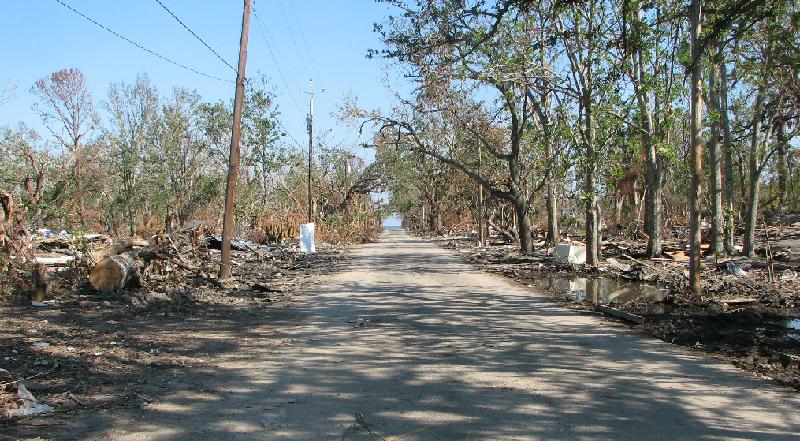
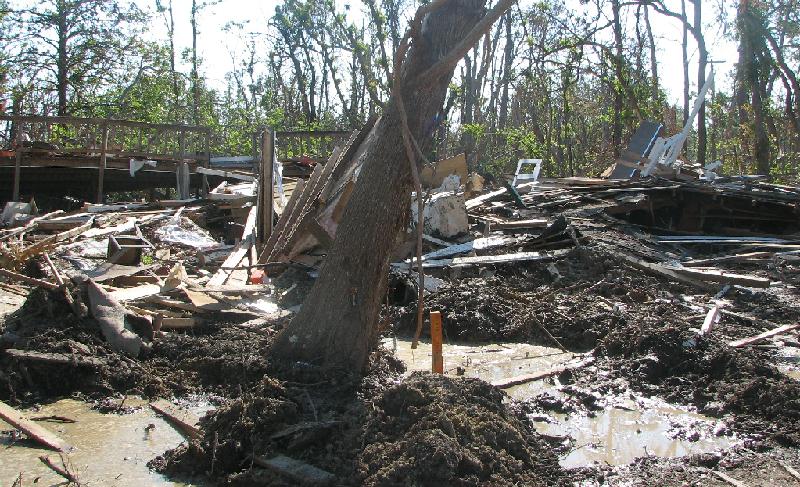
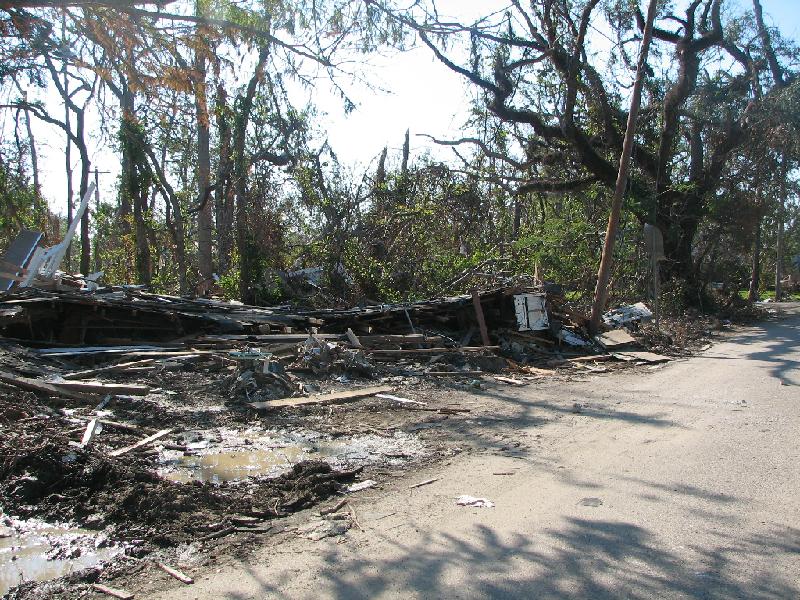
Hurricane Katrina landed on August 29, 2005. The government response fell under heavy criticism during the aftermath in the United States. Local, state, and federal government were accused of failing to prepare and respond effectively to the natural disaster. Within days, the US Government's role in preparations and responding to the storm was covered in heavy public debate. It is thought to be the largely televised footage of distressed politicians and residents who remained in New Orleans without water, food or shelter following the hurricane to be the cause of the criticism. The deaths of several citizens by lack of supplies, and the treatment of evacuees in facilities such as the Superdome also came undone to criticism in the media.
- Formed
- August 23, 2005
- Dissipated
- September 7, 2005
- Landfall locations
- Southeast Florida; Buras-Triumph, Louisiana; Louisiana–Mississippi border
Lore & Background
New Orleans Mayor Ray Nagin was widely condemned for failing to implement a flood plan and for ordering residents to a shelter of last resort without any provisions for food, water, security, or sanitary conditions. Nagin also delayed his emergency evacuation order until less than a day before landfall, leading to the deaths of hundreds of residents who were unable to evacuate. Adding to the criticism was Nagin's refusal to use a fleet of school buses pictured sitting idle in the city in an image syndicated by the Associated Press. Nagin cited a lack of insurance liability and a shortage of bus drivers for the decision to order residents to shelter in the Superdome, rather than use the available buses to assist in evacuations. A temporary coalition set up in New Orleans to deal with Hurricane Katrina was another focus of criticism. Public and private actors such as the Red Cross attempted to coordinate joint response and recovery efforts, but misunderstandings and system failures are thought to have contributed to the ineffective, temporary, and inefficient evacuation and provision of resources during the disaster.
Reader's Guide
New Orleans was already one of the poorest metropolitan areas in the United States in 2005, with the eighth-lowest median income in the country. At 24.5%, Orleans Parish had the sixth-highest poverty rate among U.S. counties or county-equivalents. The 2000 U.S. census revealed that 28% of New Orleans households, amounting to approximately 120,000 people, were without private mobility. Despite these factors preventing many people from being able to evacuate on their own, the mandatory evacuation made no special provisions to evacuate homeless, low-income, or sick individuals, nor the city's elderly or infirm residents. Consequently, most of those stranded in the city were the poor, the elderly, and the sick. The official evacuation order stated that from noon on August 28, all city buses were redeployed to shuttle local residents to 'refuges of last resort' that had been designated in advance, including the Louisiana Superdome. The orders also stated that the state had prepositioned enough food and water to supply 15,000 citizens with supplies for three days. Later, it was found that FEMA had provided these supplies, but FEMA Director Michael D. Brown had underestimated the number of citizens requiring support, and subsequently the first wave of supplies were quickly depleted. A large number of deaths were a result of the insufficient response and evacuation before Katrina's arrival, primarily due to the reluctance of city and state authorities to issue an evacuation order and risk losing face in the event the hurricane left its predicted path.
Did You Know?
- U.S. President George W. Bush signed a $10.5 billion relief package on the evening of September 2, and ordered 7,200 active-duty troops to assist with relief efforts.
- New Orleans's emergency operations chief Terry Ebbert said, 'This is not a FEMA operation. I haven't seen a single FEMA guy... We can send massive amounts of aid to tsunami victims, but we can't bail out the city of New Orleans.'
- FEMA sent hundreds of firefighters who had volunteered to help rescue victims to Atlanta for 2 days of training classes on topics including sexual harassment and the history of FEMA.
- At least two police officers committed suicide, and over 300 deserted the city after gang violence and 'turf wars' erupted around the city.
- Vice President Dick Cheney personally called the manager of the Southern Pines Electric Power Association and ordered him to divert power crews to electrical substations in Collins, Mississippi, that were essential to the operation of the Colonial Pipeline.
The Evacuation Crisis and Vulnerable Populations
New Orleans entered Hurricane Katrina as one of the nation's poorest metropolitan areas, holding the eighth-lowest median income and the sixth-highest poverty rate at 24.5 percent in Orleans Parish. A 2000 census count showed roughly 120,000 residents across 28 percent of households lacked private vehicles, making independent evacuation impossible for a significant slice of the population. Yet the mandatory evacuation order issued for the storm made no special arrangements for the homeless, the elderly, the sick, or low-income residents. The official plan called for city buses to shuttle people to refuges of last resort like the Louisiana Superdome, with the state prepositioning food and water for 15,000 people over a three-day window before FEMA was expected to arrive. In practice, FEMA Director Michael D. Brown had underestimated the number of people needing aid, and the first wave of supplies was rapidly exhausted. The result was that the majority of those stranded in the flooded city were among its most vulnerable citizens, and a large number of deaths traced directly back to the insufficient pre-storm evacuation and the reluctance of local and state authorities to issue an order they feared might look premature if the hurricane shifted course.
Mayor Nagin and the Shelter-in-Place Controversy
New Orleans Mayor Ray Nagin became one of the most criticized figures in the aftermath of Katrina. He delayed issuing his emergency evacuation order until less than twenty-four hours before the storm made landfall on August 29, a timing that left hundreds of residents unable to leave the city in time. When he did order people to take shelter, he directed them to the Superdome as a refuge of last resort without any provisions for food, water, security, or basic sanitation. Perhaps most damning was an Associated Press photograph showing a fleet of school buses sitting idle in the city while residents huddled in the domed stadium. Nagin defended his decision not to deploy those buses by citing insurance liability concerns and a shortage of available bus drivers. Critics argued that had contra-flow highway measures been activated earlier and those buses put to work, the number of people stranded in the flooded city would have been dramatically lower, and the supplies FEMA had staged would have stretched far more effectively across the population still in need.
FEMA's Federal Response Under Fire
The federal response, particularly the role of the Federal Emergency Management Agency, drew intense public scrutiny. New Orleans emergency operations chief Terry Ebbert called the effort a national disgrace and publicly questioned when reinforcements would actually reach the desperate city. He pointed out the absence of any visible FEMA command structure, stating he had not seen a single FEMA representative despite the agency supposedly being present for three days. In one widely reported incident, FEMA redirected hundreds of volunteer firefighters who had offered to help rescue victims to Atlanta for two days of training on topics including sexual harassment and FEMA's organizational history. Official requests for federal assistance through proper chains of command were delayed by local and state authorities, even after those same authorities had approached FEMA. An Appleseed Foundation report concluded that local nonprofits and municipal agencies proved far more flexible and responsive than federal or national organizations, whose staff often lacked the legal authority, training, or resources to meet the demands on the ground.
Human Toll and the Road to Recovery
The human cost of the response failures extended far beyond the storm itself. Local police, firefighters, and EMS workers described the situation as traumatic; at least two officers took their own lives, and more than 300 first responders abandoned the city after gang violence and turf wars erupted in the chaos. Outside agencies attempting to send help were often hindered or slowed by bureaucratic obstacles, and the federal response was frequently constrained by rigid eligibility requirements and a lack of legal flexibility. On September 2, President George W. Bush signed a 10.5 billion dollar relief package and ordered 7,200 active-duty troops into the affected areas, while Mayor Nagin expressed public frustration at what he described as insufficient federal reinforcements. The entire episode was amplified by heavily televised footage of distressed politicians and residents stranded without water, food, or shelter, and by the deaths of citizens in facilities like the Superdome. A temporary public-private coalition involving groups like the Red Cross attempted to coordinate recovery, but misunderstandings and systemic failures left the joint effort ineffective and fragmented.
Gallery
Frequently Asked Questions
Who is Hurricane Katrina?
Katrina was a devastating tropical cyclone that struck the U.S. Southeast in late August 2005, with New Orleans bearing the brunt of the destruction. It stands as the most expensive hurricane in American history and the deadliest since the 1928 Okeechobee event.
What were Hurricane Katrina's peak intensity stats?
At its strongest, Katrina reached Category 5 status with sustained winds of 175 mph and a central pressure of 902 mbar. These figures placed it among the most intense Atlantic hurricanes on record.
Where did Hurricane Katrina make landfall?
The storm first touched down along Southeast Florida before re-intensifying and striking the Buras-Triumph area of Louisiana. It then crossed the Louisiana–Mississippi border as it continued inland.
How does Hurricane Katrina's story end?
After forming on August 23, 2005, Katrina eventually dissipated by September 7 of that year. Its final days saw it weaken over land, though the aftermath of flooding and infrastructure collapse kept claiming lives for weeks afterward.
Why is Hurricane Katrina considered a landmark event?
With roughly 1,392 confirmed fatalities and an estimated $125 billion in damages (about $206 billion in today's dollars), Katrina fundamentally reshaped how the U.S. approaches storm preparedness and emergency response. Its impact on New Orleans' levee system and the federal government's response became a defining moment in American disaster history.
More in Natural Disasters 1-15
Spotted an error? Know more?
This is a living reference — every entry is fact-audited, and reader corrections feed straight into our audit queue. Suggest an edit · See this site's audit record